Cloud Computing

Cloud computing is virtualization-based technology that allows access to internet resources such as servers, storage, database, and other computing services.
Cloud computing helps us eliminate the problem of taking the headache of maintenance on resources. Cloud computing is based on pay as you go model. Here we need to pay for that when we use resources. Cloud computing reduces our infrastructure cost here we do not need any resources only need the internet to access your services.
Type Of Cloud Computing Deployment Model
There are mainly three types of cloud computing models.
1. Public cloud computing
2. Private cloud computing
3. Hybrid cloud computing
Public cloud Computing
Public cloud computing is a third-party managed platform that follows the standard cloud computing model to provide services remotely via the Internet. In the public cloud hardware resources are shared among similar users and also accessible over the public network. It offers such as cloud storage, Server instance, Databases, Networking, and most other services.
Examples:- AWS, GCP, AZURE, ORACLE, etc
Private cloud computing
The private cloud computing model is a secure cloud model which is hosted in a single Organization or shares some authenticated Users. It provides one other layer of security to your organization's data. It is more than secure to the public cloud computing model.
Hybrid Cloud Computing
A hybrid cloud is a combination of both public and private clouds. It is reliable and decreases efficiency and helps the Organization for providing better performance to the client. In this way, Organizations use a private cloud for hosting critical applications and delivering confidential data and use a private cloud for noncritical applications and less confidential data. In this way, you can gain the benefit of both cloud models.
Types Of Cloud Computing Service Models
According to Service based model, there are three types of cloud computing models are present.
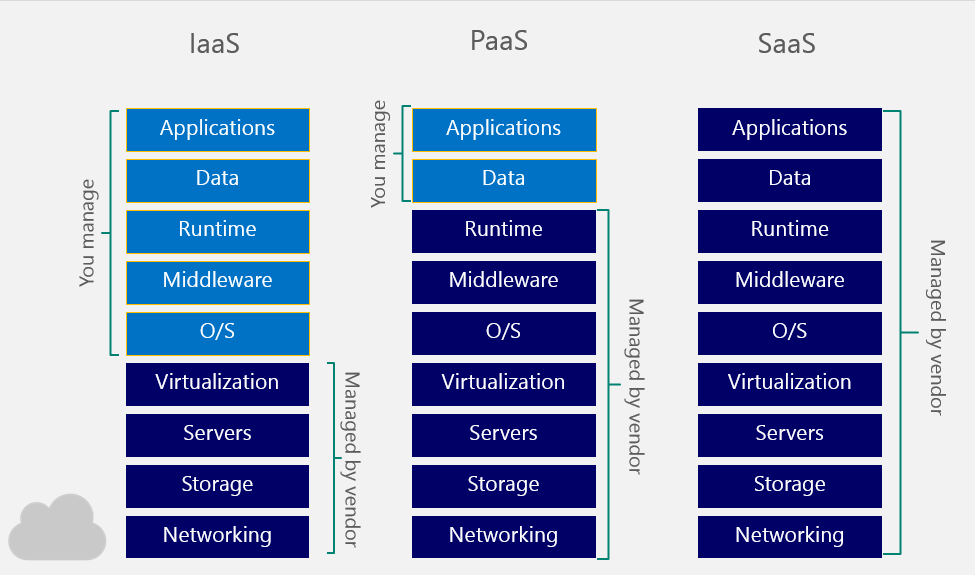
IaaS
Iaas stand for infrastructure as a service. In this service, users can use IT hardware. It provides on " pay for what you use" basis model.
example:- Virtual machine, Storage, Networking, etc.
Paas
Paas stands for the platform as a service. This provides us the platform for hosting and deploying our services here we can customize our hosted software.
it provides a runtime to deploy and test our services.
Example:-Google app engine, Opensift, Aws elastic beanstalk, Aws lamda, etc.
Saas
Saas stands for software as a service. It provides the facility for users to access the software from anywhere via the Internet.
Saas cloud provider host software and provide it to the user on a "pay as you go" model.
Example:-Office 365, Google Workspace. Salesforce.
Outlook, etc.
Benefits Of Cloud Computing
There are several benefits of cloud computing some of mention below.
- Scalability
Cloud computing allows businesses to scale up or down their computing resources based on their changing needs. This means that businesses can easily adjust their IT infrastructure to accommodate changes in demand or usage patterns.
Cost Savings
Cloud computing can help businesses save money by reducing the need for on-premise hardware and maintenance costs. Instead of investing in expensive hardware, businesses can pay for computing resources on a subscription basis, reducing the need for capital expenditures.Flexibility
Cloud computing offers businesses the flexibility to work from anywhere and at any time. This makes it easier for businesses to access their data and applications and enables employees to work remotely.Disaster Recovery
Cloud computing offers built-in disaster recovery solutions, ensuring that businesses can quickly recover data in the event of a disaster. This is because cloud service providers typically have multiple data centers in different geographic locations, providing redundancy and backup options.Collaboration
Cloud computing makes it easy for businesses to collaborate on projects and share data. Employees can work together in real-time, sharing documents, and communicating seamlessly.Security
Cloud service providers typically have strong security measures in place to protect their customers' data. This includes data encryption, access controls, and security monitoring.